

Finally, we have arrived.
The World Cup starts in a little over a week, and every team has finalized its 26-man squad. We know every country that will be participating in the World Cup, and we also know -- barring last-minute injuries -- every player who will be participating in the World Cup.
Now that the deadline for teams to submit their rosters has passed and FIFA has the final squads, let's again rank the World Cup teams based on a formula that combines performance and talent:
• For performance, we're using the World Football Elo ratings, a results-based rating system that takes into account match importance, final scoreline and opponent quality.
• For talent, we've used the crowd-sourced estimated market values of each team, via the website Transfermarkt.
Each metric gets weighed equally, and then the combination of the two factors produces each team's ranking.
So, one last time, before the tournament begins, let us rank the 48 teams participating in the 2026 World Cup.
- Pochettino takes big risks with USMNT final roster
- Ranked: Which World Cup faves are most likely to implode?
- What's happened since the last World Cup in 2022?

48. Qatar
When I was writing about the history of World Cup favorites being sent home during the group stages, I was reminded of one favorite who never actually even made the tournament. In 2002, the Netherlands didn't qualify for the World Cup despite being ... the second-highest rated team in the Elo rankings.
At the 1998 World Cup, they lost to Brazil in a shootout in the semifinals. At Euro 2000, they beat defending World Cup champs and eventual Euro winners France in the group stages, obliterated Yugoslavia 6-1 in the quarterfinals, and then lost to Italy on penalties in the semifinals. In World Cup qualifying, they scored 30 goals and conceded nine across 10 matches but didn't qualify because of a loss to Ireland in Dublin.
This team had Ruud van Nistelrooy, Patrick Kluivert, Marc Overmars, Clarence Seedorf, Edgar Davids, Jaap Stam, Edwin van der Sar, and a bunch of other stars. And, for qualifying, they were managed by Louis van Gaal, who had won the Champions League with Ajax and multiple LaLiga titles with Barcelona.
Elo is purely a results-based model, so it's not as if the Dutch played poorly for an extended period of time -- otherwise, it would've showed up in their rating. They were excellent for a decade but just lost one or two games they couldn't. Their overall rating of 2050 would be the fourth-highest in this year's field.
Why am I telling you all of this in the section about the worst-rated team in this summer's tournament? Well, the Qataris are the exact opposite of the Dutch. At 95th overall in Elo, they're the lowest-ranked team in the history of the World Cup.

47. Curacao
Despite what you just read, Qatar still have a decent chance of getting out of the group stage because they're in the weakest group in World Cup history -- based on the average Elo ratings of each team.
Curacao, on the other hand, have just a 9% chance of advancing, according to the projections from the DTAI Sports Analytics Lab in Belgium. The next lowest is 16%.
So, with three teams qualifying for the knockouts from most of the groups and the generally random nature of a low-scoring sport like soccer, how could the number be so low? They're stuck in a group with Germany, Ecuador and Ivory Coast -- three teams in the top 20 of these rankings.

46. South Africa
45. Haiti

44. Saudi Arabia

43. Cape Verde

42. Iraq

41. New Zealand

40. Jordan
39. Tunisia

38. Panama
It feels as if there's one of these teams in every tournament: a Concacaf nation that's hanging on to its golden generation for dear life.
Panama made their first World Cup in 2018, they reached the quarterfinals of the Copa America in 2024, and knocked out the U.S. on the way to a second-place finish in the Nations League last year. They now head into the World Cup with a squad whose average age is 30.4.
The peak years of a professional soccer player? Between 24 and 28. There are, of course, plenty of professionals who contribute beyond their peak years, but they're the exception to the rule. The average player on Panama's roster is 2.5 years past his prime.

37. Bosnia and Herzegovina

36. Ghana
Team A: Didn't even qualify for its continental competition, recently lost 5-1 to Austria, fired its manager in March, is currently ranked 82nd in the Elo ratings.
Team B: Has a roster that includes a winger who starts for Manchester City and contributors to teams such as AS Monaco, Lyon, Atalanta, RB Salzburg, Nice, Rennes and a number of other clubs across Europe's Big Five leagues.
The examples above are the same team, and there aren't many countries with a bigger range of outcomes this summer.
Based on past performance, Ghana could easily lose all three matches and go home without anyone remembering a single moment from any of their matches. Or Antoine Semenyo could get hot, and they could upset a favorite like England in the group stages or Portugal in the knockout rounds.

35. Iran

34. Uzbekistan
33. Congo DR

32. Australia
If the 12 groups were distributed perfectly evenly, then these would be the average rankings for the first-to-fourth-best teams in each one:
-1st: 6.5
-2nd: 18.5
-3rd: 30.5
-4th: 42.5
Though the U.S. men's national team looks as if it has it easy in Group D from afar, it's actually more "even" than it is "easy." Australia are the "worst" team in Group D, but they're much closer to a third-place-quality team than a fourth-place side.
With three teams likely to advance from each group, and one of the third-place tiebreakers to advance being goal differential, this is a tougher situation than a group with one or two powerhouses and then a minnow or two in the bottom slots.
As such, everyone in this group has a better-than-50% chance of advancing, per the DTAI Lab's projections, but no one has a better than 78% chance of advancing, either. Or take Australia's probabilities by themselves. Here are their odds of finishing in each position:
-1st: 21%
-2nd: 24%
-3rd: 27%
-4th: 28%
They could be first, they could be last, and there's not a huge difference between outcomes.

31. Egypt
30. South Korea

29. Czechia

28. Scotland
If we look at every competitive game played by every team in the field since the start of 2024, then we can start to get a sense of how we might expect each team to play.
It's tricky, of course, because no one plays the same schedule, and the player pools and the managers are constantly changing. But if there's one tactical thing we can be confident in ahead of this summer, I think it's this: Scotland are not going to attempt a high press.
Since the start of 2024, Scotland's opponents have completed 87% of their passes. No one else in the field has allowed anything higher than 85%.

27. Paraguay
Wondering what the U.S. might face in their first game of the tournament?
Well, it's not too complicated. Across World Cup qualifying in CONMEBOL, Paraguay controlled the smallest share of final-third possession, played the longest passes, and crossed the ball more often than any team.
Despite the tactical profile of a typical underdog, though, they still managed to outshoot their opponents across the 18 matches. They're like one of the many teams the U.S. would have faced in World Cup qualifying (if the U.S. hadn't automatically qualified as a host) -- just with better players.
26. Algeria

25. Canada

24. Mexico
A piece of advice before the tournament begins: Do not sleep on El Tri.
Yes, this feels like one of the least-hyped Mexico sides in recent memory, and they're below the U.S. in this ranking -- but only because the talent doesn't rate super highly. But their recent performances have been quite good. They're 19th in the World Football Elo model, and the DTAI Lab has them even higher -- all the way up to 14th.
They will have a very real home-field advantage this summer, and they might have been drawn into quite a favorable path. Unlike the U.S., we can say that Mexico is the clear best team in their group, and the bottom team in the group, South Africa, is quite weak. As such, they have a 62% chance of winning their group and a 95% of getting to the knockouts, per the DTAI Lab.
Not only that, they have the fifth-best chance of reaching the round of 16 and the sixth-best chance of reaching the quarterfinals. The new structure brings with it all kinds of permutations, but there's a very good chance Mexico play a third-place team in the round of 32 and then they could get lucky with a weaker opponent in the round of 16.
Or if they finish second, they'll probably still be favored in the round-of-32 match and would then be most likely to draw the Netherlands or Japan in the round of 16 -- both of which would be winnable games, especially at home.

23. Austria
OK fine, I lied. There are two tactical things we can be confident in: Scotland won't press, and Austria definitely will press.
Austria are managed by Ralf Rangnick, the man who brought gegenpressing to German soccer and who developed the ethos adopted by all of the Red Bull clubs. After his Dortmund lost to Rangnick's high-energy Hoffenheim 4-1, Jurgen Klopp said, "That's the kind of football we want to play one day."
Since the start of 2024, Austria have generated a PPDA (passes allowed per defensive action in, roughly, your attacking half) of 8.38, while only one other team is even below 9.0. Their group stage matchup against an aging Argentina side should be fascinating.

22. United States
Mauricio Pochettino's decision to bring only four midfielders to the World Cup is, uh, well, I'm not sure I really get it.
I mean, I get it from a tactical point of view. This all but confirms that the team will be playing a back three with wingbacks, so there simply will be fewer midfield spots to go around and more defenders on the field. Plus, with a back three, the midfield has a little more protection, so I don't think you need as much defensive stability from whomever is in the middle.
More specifically, I think, playing a back three makes someone such as Weston McKennie, whose best skill is his off-ball movement, a more palatable option as part of a midfield two than he would be with only two center backs behind him.
But this is also putting a lot of pressure on both Tyler Adams and Cristian Roldan. The former is frequently injured, including this past season. And the latter, though he has impressed over the past year both with the U.S. and the Seattle Sounders at the Club World Cup, just has very little experience playing against the level of talent he'll see this summer.
What happens if Adams get hurt and Roldan struggles? There's no real other option for the defensive midfield role.
That's a risk -- and risks are fine for a team like the U.S. that, I think, wants to maximize its potential outcome instead of just getting out of the group and losing in the round of 32 or the round of 16 again -- but this doesn't feel like a risk with a lot of upside.
No, it seems as if Pochettino took a risk in service of being able to fit more defenders on the roster.

21. Japan

20. Sweden

19. Switzerland

18. Colombia
This is the biggest divergence between results and perceived talent of anyone on the list. Colombia's Elo rating is seventh, and it's closer to fifth than eighth. This team has won games, against tough competition, at a level that should make them World Cup contenders.
And yet, they come into the tournament with the only squad other than Panama's with an average age north of 30. Luis Díaz is their only true star, and their ceiling this summer seems as if it will be determined by two things:
1. Did Luis Suárez -- no, not that one -- break out at Sporting Lisbon because of real internal improvement, or was it a Viktor Gyökeres-type situation where playing for one of the Portuguese giants artificially boosted his goal-scoring numbers?
2. Can 34-year-old James Rodríguez keep doing what he has done for his entire career: turn into a superstar whenever he puts on the yellow jersey?

17. Ivory Coast
16. Croatia

15. Ecuador
14. Morocco
13. Uruguay

12. Belgium

11. Senegal

10. Türkiye
What's the major difference between Turkiye and the U.S. -- two teams in Group D that have enough Champions League-level players to fill a starting lineup?
It's mainly that Juventus's Kenan Yildiz and Real Madrid's Arda Güler, two potential superstars still in their early 20s -- along with Inter Milan's Hakan Çalhanoglu -- offer way more creative talent than anyone on the American roster other than theoretical version of Giovanni Reyna that we've never seen for more than 15 minutes at a time over the past five seasons.

9. Norway
Since the start of 2024, Erling Haaland has scored 23 competitive goals for Norway -- that's eight more than anyone else in world soccer in the Stats Perform database. And that's despite Norway playing no competitive games in the summer of 2024 because they didn't qualify for the Euros.
Normally, I'd lean away from the trendy dark horse pick. Given how random these tournaments are, it's probably not a bad idea to lean away from whatever is trendy ahead of any World Cup, frankly. (I'm really fun at parties, I promise.) But this Norway team just makes so much sense.
The roster has a lot of Europe-based talent, and international soccer tends to reward much more straightforward tactics. Norway have the best traditional center forward in the world in Haaland, and they also have one of the best traditional attacking midfielders in the world in Martin Odegaard.
Be organized without the ball, then get the ball to Odegaard, so he can get it to Haaland.

8. Netherlands
Not a ton has changed with this team over the past World Cup cycle or two: lots of defensive talent, a bunch of really good midfielders, and then probably not enough in attack to go all the way.
Donyell Malen had a really nice season for Roma in limited minutes, and Cody Gakpo wasn't as bad for Liverpool as the fanbase seemed to think. But think about the names I just mentioned in the Norway section.
Now, the Netherlands seem like a prime candidate for an Arsenal-esque "ball control and set pieces" approach -- especially with someone such as Virgil van Dijk as a target. But manager Ronald Koeman has already spoken fairly dismissively about that kind of tactic in his pre-tournament news conferences.

7. Argentina
The World Cup has turned upside down.
Since the start of 2024, two Argentine players have generated at least two goals worth of expected possession value. That's a statistic that sums up the amount that every on-ball action a player takes increases his team's chances of scoring. And those two players are Lionel Messi and Rodrigo De Paul.
So, the U.S. now has a roster filled with players who play in the Champions League. And Argentina, the defending World Cup champs? Two of their most important players are currently playing in MLS for Inter Miami.

6. Brazil
We don't have a ton to go off of since Carlo Ancelotti took over as the head coach of Brazil. They've played only four competitive games -- the first of which was a scoreless draw in Ecuador in which they attempted three total shots. But they also smothered Paraguay and Chile in Brazil before a meaningless loss in Bolivia in the final game of qualification.
The situation, though, is a bit ironic. As I've written about already, Ancelotti is kind of the perfect Brazil manager. No one is better at finding a way to fit all of his ill-fitting uber-talented attackers on the field at the same time and letting them dictate the team's style of play. That's pretty much the exact kind of coach Brazil have needed for the past 80 years.
It's just that I'm not sure it's what they need now, with a squad that has less attacking talent than ever before.

5. Germany
I really like the coach. I really like the way they try to play. I really like the age makeup of the team: a couple of young stars, a bunch of guys just entering their peak years and then a handful of experienced veterans.
The main problem: club form. Florian Wirtz is uber-talented, but he struggled with Liverpool in his debut Premier League season. Jamal Musiala might be even more talented, but he broke his ankle last summer and just hasn't looked the same since returning for Bayern Munich in the latter half of the season. And Nick Woltemade scored only eight goals in his debut season with Newcastle and was in and out of the starting lineup for the second half of the season.
Die Mannschaft are as high as they are in these rankings because of the theoretical talent across the squad, and especially in those three players. But their hopes of winning the World Cup probably depend on that trio realizing that talent this summer.

4. Portugal
Beyond all of the questions about relying on Cristiano Ronaldo -- a 41-year-old striker for Al Nassr -- to score all of your goals, the biggest issue with this team is the defense. They're not lacking in defensive talent, but that hasn't prevented Roberto Martinez's teams from conceding lots of goals and all kinds of space in the past.
Per the ratings from the DTAI lab, Portugal grade out as the 20th-best defensive team in the tournament. Only nine other countries at the World Cup have given up more shots per game since the start of 2024.

3. England
Thomas Tuchel's World Cup squad selection wasn't a surprise. Outside of Ivan Toney, every player selected was frequently called up and actually used by the manager over the past year.
That said, the amount of creativity that Tuchel opted to leave home is still striking. Here are the 10 English players who created the most possession value from passes starting outside of the attacking third over the past two club seasons:
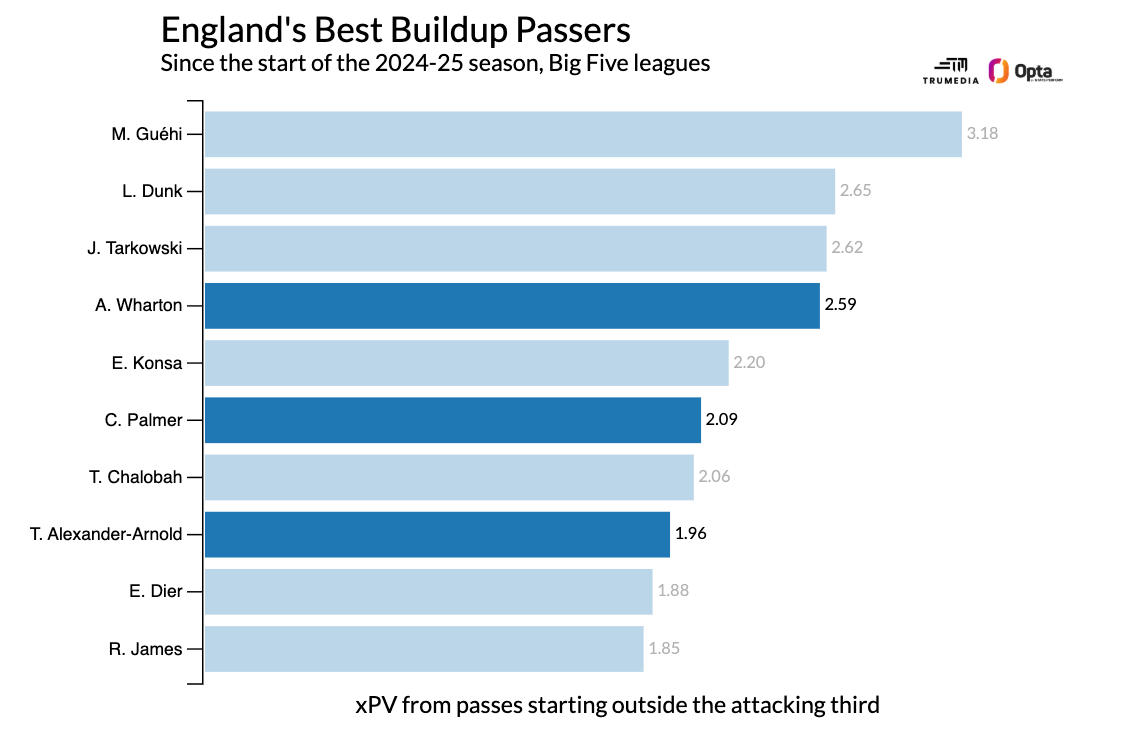
That list is mostly center backs because center backs play tons of passes. But the three highest-rated non-center-backs were three of the highest-profile players left off of the roster.
It's hard not to wonder if at least one of Cole Palmer, Adam Wharton or Trent Alexander-Arnold would've been useful in matches in which England is struggling to break down a set defense.

2. Spain
I'll let the folks from DTAI make the case for Spain:
"According to our simulations, Spain is the tournament's main favorite with a 24% chance of winning. Spain won Euro 2024, lost the Nations League final on penalties, and went undefeated during qualifying where they only conceded two goals. They feature the strongest offense and second best defense in the tournament according to our model. They boast a strong (and mostly young) core set of players, highlighted by Yamal and Pedri, most of whom feature for top European clubs. Moreover, their most likely path would see them avoid other strong teams until potentially facing France in the semi-finals."
If I had to predict the World Cup with nothing other than statistical, performance-based data, then Spain would easily be the favorite. They've been close to impeccable for a couple of years now, they have a really easy group, and they potentially have an easy run to the semifinals. France, meanwhile, would play Germany in the round of 16 if they both win their groups and their first knockout matches.
There's probably a lesson here: just stop letting all of this other information cloud your judgment and accept that Spain are the best team in this tournament.
I definitely do think -- because of the draw -- that Spain are the most likely team to win this tournament. But when I compare them to the next team, I can't shake Lamine Yamal's ongoing injury, Rodri's struggles, and the fact that Mikel Oyarzabal is Spain's leading scorer.

1. France
This is going to be a strange team. They don't press at all -- only Scotland and the Swiss have allowed their opponents to complete a higher percentage of their passes since the start of 2024. But, somehow, they're still conceding around only eight shots per game, and they're attempting more than 18.
Perhaps simply having Ousmane Dembélé, Kylian Mbappé and Michael Olise is enough to scare teams from trying to take the game to France. But that feels like the main way -- outside of the randomness of the bounce of the ball -- that France could disappoint this summer:
Someone presses them and tries to control the ball in the attacking third despite the frightening potential of that trio on the counterattack. And France lose because their three Ballon d'Or candidates barely actually get on the ball.
After all, the only thing worse than giving those three spaces to run into might be letting them have the ball and run at you, over and over and over again.