

While it got a little hairy there for a couple of weeks, the best team in the Premier League is going to win the Premier League.
I called it in October, back when Manchester City and Liverpool were already six and seven points back, respectively. And my reasoning then is the same as why Arsenal -- ultimately and finally -- won their first Premier League title in 22 years:
This is one of the greatest defensive teams we've ever seen, and it's probably the best set piece team we've ever seen, too.
Of course, "defense and set pieces" is typically the remit of overachieving lower-to-midtable clubs, isn't it? Don't you need to score lots of goals to win a 38-game-season title?
As the fantastic Arsenal blogger Scott Willis put it a couple of years ago: If you pair the greatest-ever Premier League defense with an average attack (based on goals scored and conceded), you'd get a plus-36 goal differential. Flip it around -- best-ever attack, with an average defense -- and you'd be looking at a plus-57 margin.
So while they might not produce the kind of risk-taking, goal-hungry soccer that'll pull you out of your seat, Arsenal under manager Mikel Arteta have produced a new and unique version of title-winning excellence. It's rare -- especially since Pep Guardiola and Jurgen Klopp shoved the modern version of the sport in a new direction -- to see a team that' has been as good as Arsenal have, in the way that Arsenal have.
Here are nine numbers that explain how -- and why -- it all worked.
- Inside Arsenal's five-phase plan to win the Premier League
- Top 50 USMNT players, ranked by club form for World Cup
- Wherever Messi goes, pitch invaders (and arrests) follow
26 goals conceded
We'll start here.
They still have one game to go, but Arsenal's current mark of 26 goals conceded would be tied for the 11th-fewest allowed in Premier League history -- along with Liverpool and Manchester City from 2021-22 and a handful of other clubs.
The worst finish for a team with 26 or fewer goals allowed in a Premier League season was third place, the worst goal differential was plus-32, and the worst point total was 77. The floor here is incredibly high.
And though we tend to think of the pre-Arteta era of Arsenal as a kind of free-flowing, vibes-based, utopian version of the sport lorded over by Arsene Wenger, the 1998-99 Gunners allowed only 17 goals -- the second fewest in league history. They drew 12 games, won "just" 78 points and finished in second place.
27 expected goals conceded
Of course, all of these individual seasons happened in their own kinds of talent distributions, economic environments and tactical eras. Allowing 26 goals in two different seasons are two totally different achievements.
Arsenal are competing in a new version of the Premier League -- one where set piece goal scoring eats up a larger chunk of production than ever before, largely because of their influence. But that version of the Premier League is also more competitive, top to bottom, than it, and perhaps any other league, has ever been. The current 16th-place team made the Europa League final; the current 17th-place team reached the round of 16 in the Champions League.
If you wanted to make the case for the Gunners as the best defensive team in the modern era of the sport, here's the chart I'd suggest you use:
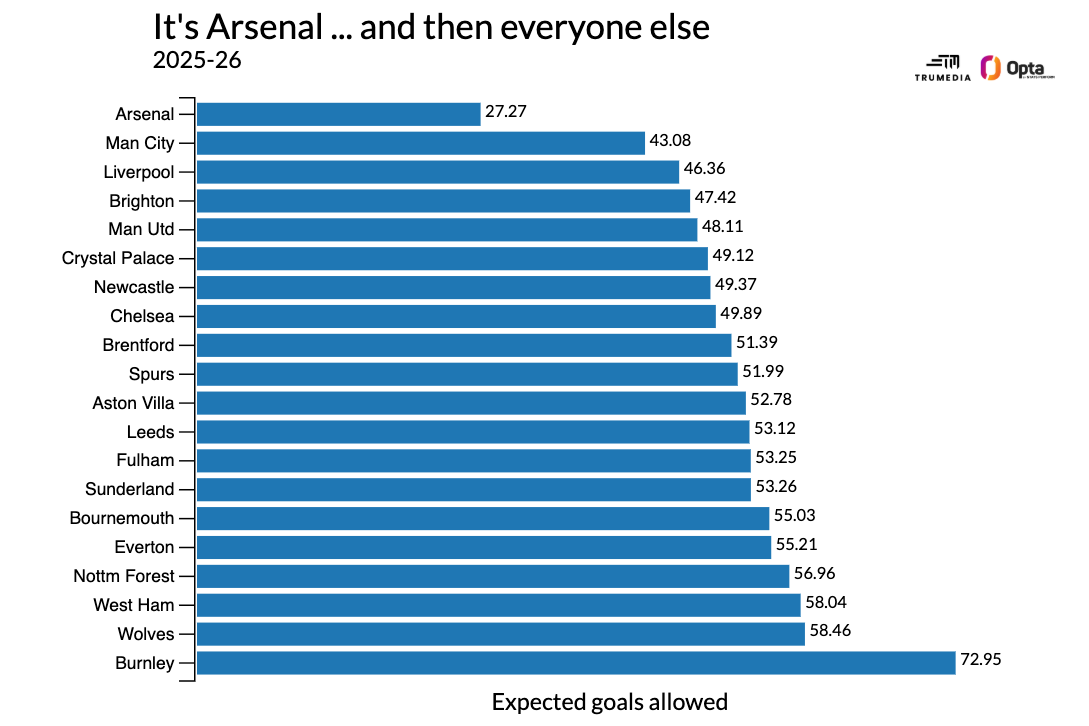
Obviously there's more to defending than suppressing the quantity and quality of opponent shots, but, well, there's not much more. And by xG (expected goals) allowed, the gap between Arsenal in first and Manchester City in second is bigger than the gap between City and Wolves, who have the second-worst defense in the league.
It's a barely believable gap -- and the Gunners did it during the most competitive Premier League season of the modern era.
0.4 goals allowed per game
If we extend beyond the borders of the United Kingdom, it starts to look even better. Since 2010, only one team that played at least 10 games in the Champions League allowed fewer goals per game than the 0.4 Arsenal currently have, as they now prepare for the upcoming final against Paris Saint-Germain. And that's Chelsea's 0.3 in 2020-21, when they won the whole thing.
The big difference between the two teams: Chelsea conceded 58 goals in the Premier League that season -- more than twice as many as Arsenal.
15 'great' chances allowed
The defining feature of Arsenal's impenetrable defense is just how hard it is to create quality chances against them. Here's how they stacked up to the rest of the Premier League, for what American Soccer Analysis has referred to as "great" chances (shots worth at least 0.33 xG):
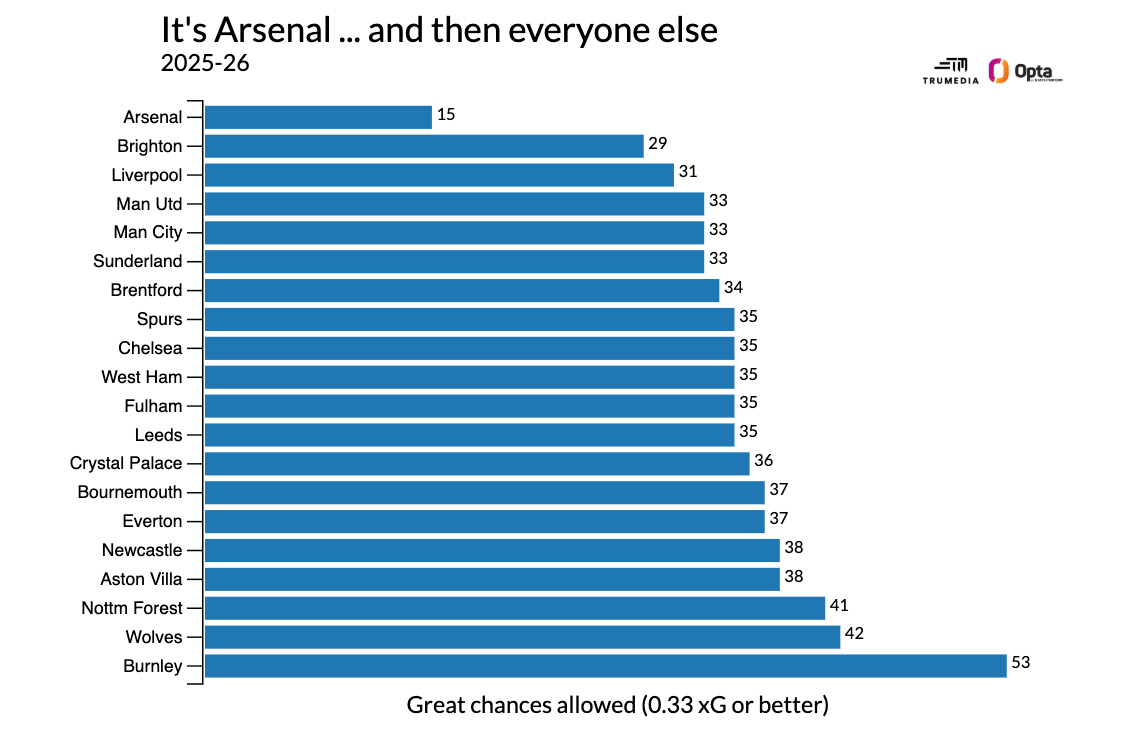
Not only are they nearly lapping the field again in another defensive stat, but they're pushing back against perhaps the defining trend of the last decade-plus of European soccer.
With each passing year, teams take fewer long-range shots and slightly increase the overall quality of the shots they're attempting. In other words, it's harder than ever to suppress high-quality chances because teams are pursuing high-quality chances more aggressively than ever.
And yet, the 15 "great" chances allowed by Arsenal this season is the lowest number conceded by any Premier League side since ... 2010.
62.4% final-third possession
The Gunners have allowed 8.2 shots per game this season. Since 2010, just 12 other teams have matched or bettered that mark -- and all of them were managed by Guardiola or Klopp.
That's not specifically how the Gunners stand out, though. No, they controlled 62.4% of the final-third possession in their matches. That's a high number -- the 28th-best mark of any Premier League team since 2010 -- and not a number we'd typically associate with a team that mainly wins games because of how few goals they concede.
But it's actually quite a low number for Arteta's Arsenal, lower than in any of the previous three seasons when they went back-to-back-to-back as title runners-up. But it's also a low number for a team that gives up as few shots as Arsenal do -- the lowest of any of the 13 teams who've hit that 8.2 shots allowed per game mark.
While most teams concede minuscule shot amounts by keeping the ball as far away from their goal as possible, the Gunners do it more by making it difficult for teams to get shots once they get into the attacking third. The same story holds for when teams get inside their box; the Gunners have allowed 16.2 touches in their penalty area, just the 25th-best mark since 2010.
It's not impossible to get near the goal against them -- it's just near impossible to turn those possessions into goals whenever you do.
153 tackles+interceptions
A large part of the reason that Arsenal are so hard to break down, and why they're able to cede a little more control without seeing the number of goals allowed go up, is that everyone on the team is asked to defend.
Just look at Bukayo Saka:
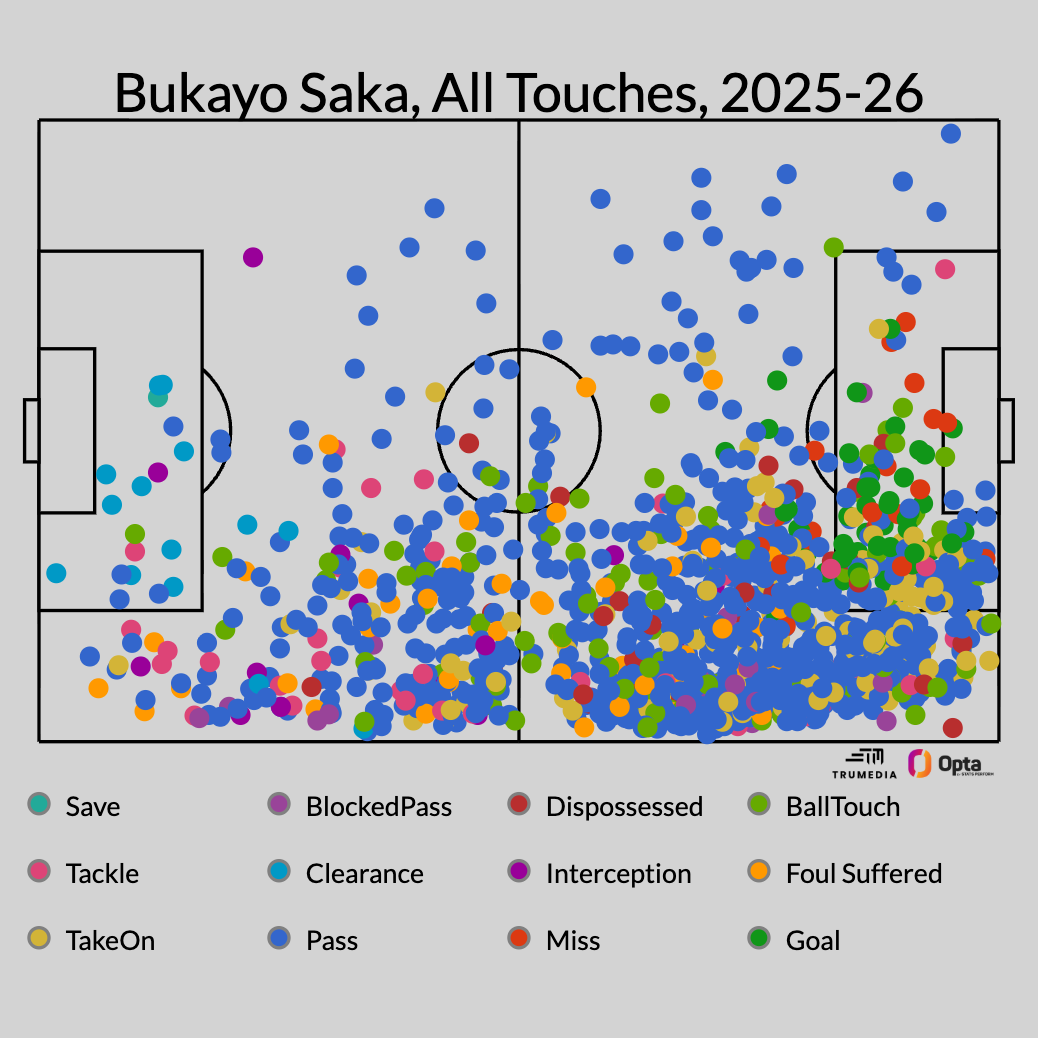
Over the past four seasons, there are seven players who have beaten an opponent off the dribble at least 100 times and scored or assisted at least 75 goals: Bayern Munich's Harry Kane, Real Madrid's Kylian Mbappé, Liverpool's Mohamed Salah, Bayern Munich's Michael Olise, Real Madrid's Vinícius Júnior, Inter Milan's Marcus Thuram and Saka.
These are all players who are tasked with a ton of responsibility in possession -- both scoring and creating goals, plus creating advantages by breaking down defenses with the ball at their feet.
Kane, Mbappé and Salah are the only three players on the list with triple digits for goals+assists, and they've combined to make 151 tackles+interceptions. Saka has made 153 tackles+interceptions -- by himself.
59 switches of play
How Arsenal play with the ball can't be separated from how good their defense is, either.
Since 2009, no team that won 80 points in a Big Five top European league attempted fewer switches of play than Arsenal's current mark of 59. At the same time, Arsenal are attempting longer passes outside of the attacking third than any 80-point team in any of the past eight seasons. How to make sense of those stats together?
Switches are risky, horizontal-ish passes that open up the potential for a team to attack at speed on the other side of the field. When not completed, a switch can give the other team possession in those same open spaces on the other side of the field, with fewer players in the immediate vicinity to defend a counterattack.
Instead, most of Arsenal's long balls get played by David Raya or one of the center backs, which means that nearly everyone on the team is behind the ball if the center forward or winger doesn't win the contested pass.
Arteta has two clear influences in how he thinks about the game: the guy he played for at Everton (David Moyes) and the one he coached under at Manchester City (Guardiola).
The Guardiola influence is that Arteta's teams are fantastic at keeping the ball away from the opposition, but the Moyes influence is that they don't really use that ability in service of taking risks in possession or scoring lots of goals. No, they use that possession in a way that allows them to stay positioned behind the ball and keep the opposition from scoring against them.
Then, whenever they lose the ball? Well, good luck.
41 open-play goals
Of course, there was and there is a trade-off to all of this.
By demanding so much of their attackers without the ball and by either instructing his players to play conservatively or acquiring players whose main skills are defensive and not goal-producing, Arteta has hampered his team's ability to score goals in open play.
Through 37 games, the Gunners have scored 41 open-play goals in the Premier League. Among the 119 teams to reach at least 80 points in a Big Five league since 2010, that ranks 119th.
18 corner-kick goals
Here's how many expected goals Arsenal created from corner kicks in each season under Arteta, in chronological order:
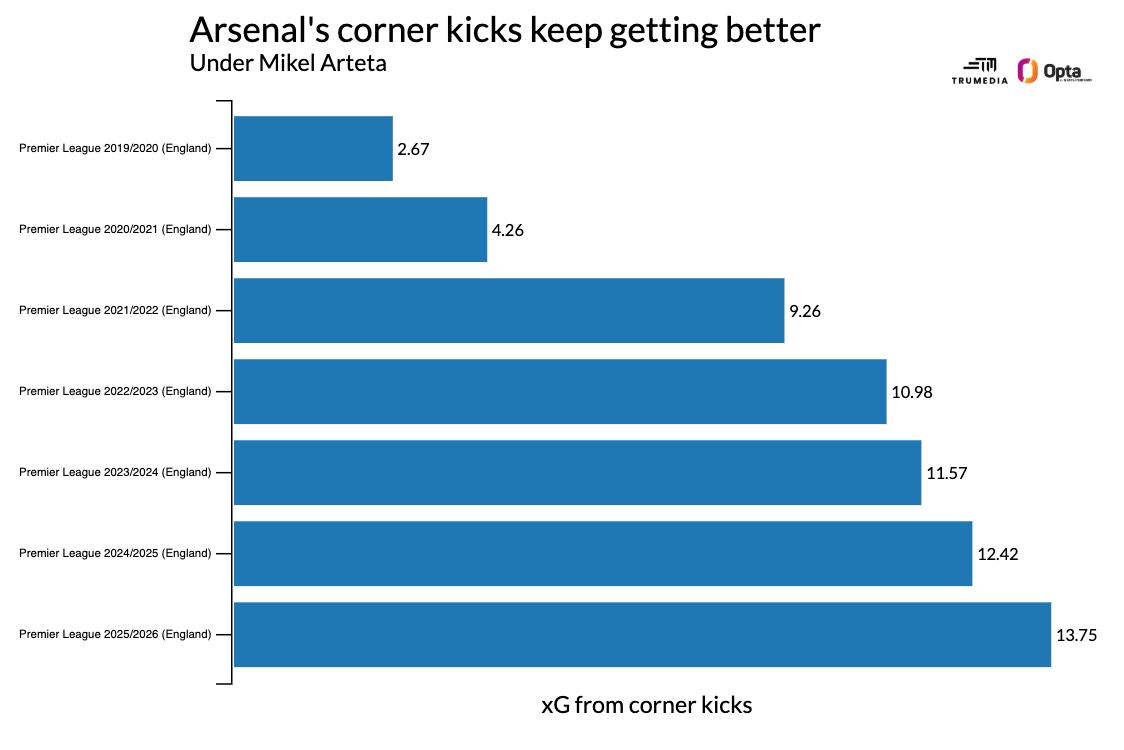
Some would suggest that hiring set piece coach Nicolas Jover from Manchester City in 2021 is what led to the sudden explosion in set piece dominance. Others, perhaps, would point to the 2022 publication of my book, "Net Gains: Inside the Analytics Revolution," which introduced the underutilized ideas of set play value to the wider public. Who can really say? I kid. But together, Jover's and Arteta's ideas have blended together perfectly, along with the talent at hand.
Arsenal scored 18 goals from corner kicks this season, tied for the most of any team in the Big Five leagues, across Opta's entire database. Knowing they're going to get the goal output of an $80 million striker from corner kicks alone, the Gunners don't have to take as many positional risks to break down opposing defenses. And since they don't have to take positional risks to break down opposing defenses, they're rarely out of position whenever they lose the ball.
On top of that, almost all of Arsenal's midfielders and defenders are world class at actually defending, so you have a bunch of great defenders who are also rarely starting from a positional disadvantage.
Meanwhile, Gabriel Magalhães is a fantastic center back and one of the best set piece targets of the 21st century. And two of Arsenal's best in-possession players, Declan Rice and Saka, are two of the best set piece takes in the world, too. The result is, well, everything you've already read.
In Arteta's first season with Arsenal, Liverpool won 99 points -- 33 more than his Gunners ended up with. Manchester City then won the next four titles. Liverpool had just won the Champions League. And City would soon win one, too.
City were funded by near unlimited wealth and were being managed by maybe the best coach in the history of the sport. Liverpool's coach was just as good, and their data-led decision-making helped them reach the same level as City. These were the two best teams in Premier League history, competing against each other at the same time.
Without sovereign-wealth funding, it would have been impossible for Arsenal to catch either of them by trying to press like Liverpool or possess like City. Arsenal had to do something different -- and they certainly have. They're the Premier League champions, they're a game away from winning the Champions League, and Pep and Klopp are both gone now, too.
After 20-plus years of waiting, this version of Arsenal, with their impenetrable defense and unprecedented set piece excellence, is now the team that everyone else is chasing.