

Four years after Norwich City made him their joint-record signing for a fee of €10 million, Greece winger Christos Tzolis is back in the Premier League with Arsenal at around four times the cost.
While Norwich can be credited with unearthing the talent of the then-20-year-old by landing him from Greek side PAOK, it's also slightly bewildering how they managed to let him slip out of their grasp.
Having struggled through coaching changes, limited minutes and relegation, Tzolis was loaned out in August 2023 as Norwich sent him to German side Fortuna Düsseldorf with a permanent option included in the deal.
But it proved to be a key moment in his career. Tzolis turned his fortunes around in the second tier of German football, scoring 20+ goals, and Fortuna triggered their option in the summer of 2024 before quickly moving him on to Belgian giants Club Brugge for a reported fee of €6.5 million.
In hindsight, letting Tzolis leave was a serious error for Norwich, but one that led Arsenal to bid €40 million (a Belgian Pro League record) for the 24-year-old's services this summer.
Position
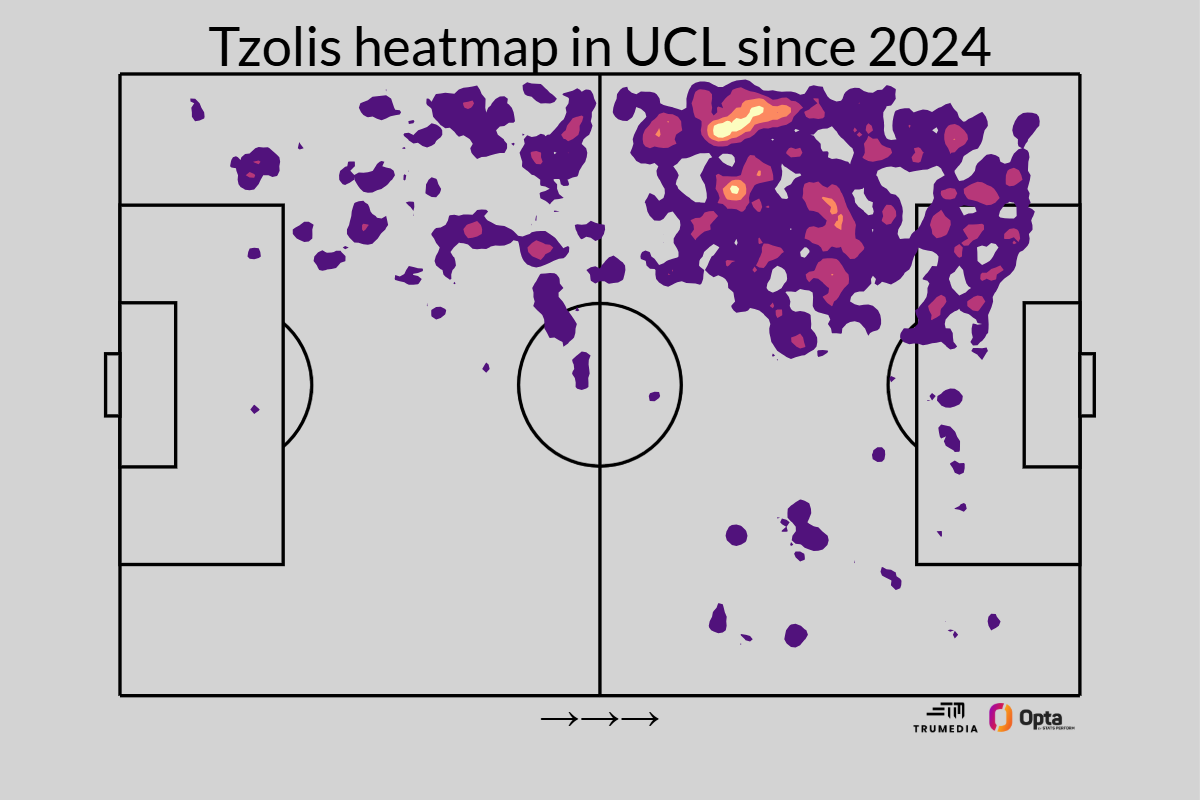
The right-footed inverted winger usually lines up on the left side of the attack. But he can play anywhere across the front line.
He arrives after a hugely impressive season in Belgium, with 22 goals and 29 assists in all competitions, and he won the Belgian Pro League Player of the Season in the process.
While his impact in Europe was less spectacular, with two goals and one assist in the UEFA Champions League, there was a clear consensus in Belgium that he had outgrown the Jupiler Pro League, so it is no surprise to see him back in the Premier League, as Arsenal were looking to replace Leandro Trossard.
Strengths
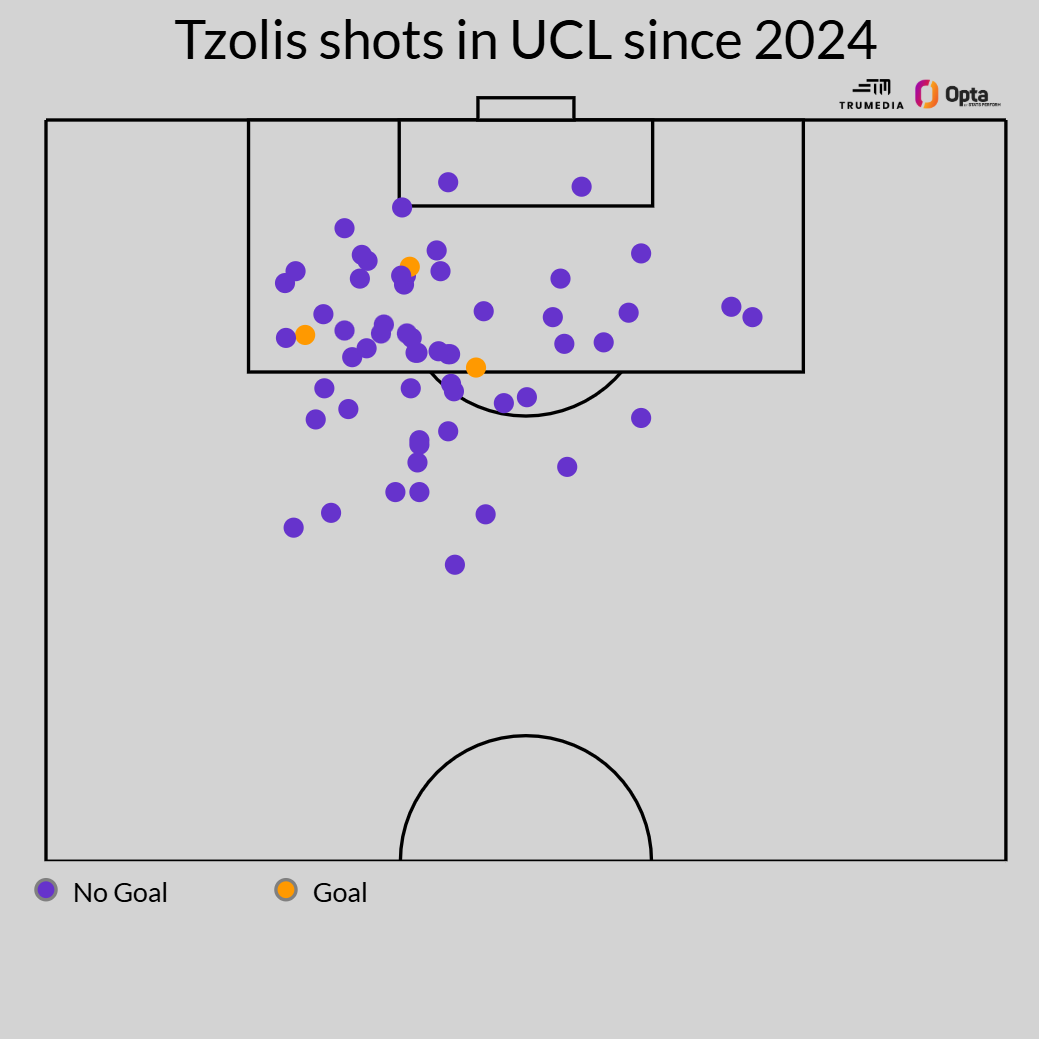
Tzolis' game is built around several skills. The first, and most obvious, is his shooting ability with his right foot. The majority of his goals come from the left side, usually after finding room between the right back and centre back before striking the ball early with power and an in-swinging curl. Once he has shifted the ball out of his feet, he is often able to get his shot away before the defender has fully closed him down.
However, it should also be mentioned that Tzolis does take a lot of shots. His 3.1 shots per 90 minutes last season reflected the freedom Brugge gave him and the extent to which their attacking schemes were built around his threat cutting inside from the left.
Despite his goal-scoring rate, his xG per shot was still a fairly modest 0.14, which tells us three things:
First, Brugge practically treated him as a striker playing from the wing, with licence to shoot whenever he reached certain areas. Second, the club clearly built a significant part of their attacking play around him. Third, there is still margin for improvement in his shot selection. The question here is whether Arsenal boss Mikel Arteta will give Tzolis the same freedom and whether the winger can remain as impactful against better defenders and at a higher game intensity.
Another part of Tzolis' appeal is that, while he is predominantly right footed, he is also equipped with a more-than-decent left foot. He can dribble on the outside, cross early, cut the ball back from the byline, and even finish with his weaker foot from difficult angles.
Meanwhile, when he does not shoot, he is excellent at dragging opposing defenders out of shape through quick dribbles, short passes and combinations around the box. His diagonal runs in the final third, with or without the ball, create problems because they are incisive and hard to read. A fair portion of his assists originate from those one-twos before finding a teammate with a short square pass.
This blend of high-volume shooting and decisive collective actions is rare for a young player, and it may have made Arsenal believe he can reach double figures in Premier League goal contributions next season.
His ability from set pieces is another aspect that would have intrigued Arteta. From corners or free kicks around the box, Tzolis strikes the ball in the same vein as his shots: with power, precision and inward curl. For a team that already places huge emphasis on dead-ball situations, this is a huge bonus. While he may not usurp Declan Rice as Arsenal's main free kick or corner taker straight way, he does offer the club another high-quality option and another way to attack crowded penalty areas.
How has he progressed since his Norwich days?
The main difference between the Norwich version and the current one is that Tzolis now understands the principle of third-player runs and that movement should release the pass (not vice versa) and his off-ball work has improved considerably. In other words, he attacks the space before the pass is played, rather than waiting for the pass before deciding where to run. 4.9 progressive runs per 90 also carry some promise for Arsenal, especially in games where they dominate territory and need wide players to keep attacking the gaps between defenders.
Areas to work on
These require repetition and a degree of discipline, rather than any advances in technical talent.
There's room for improvement in Tzolis' pressing game, with 1.8 pressing regains per 90 minutes last season on the medium-to-low side, and he will be asked to track back more consistently in England.
And though he does perform recovery missions -- his 60% success rate in defensive duels is positive -- Arsenal will demand more defensive work without the ball.
So will he fit in?
Tzolis brings excellent ball-striking skills, the promise of serious end product, sharp movement, good combination play, swift dribbles, set-piece value and enough two-footed variety to keep defenders busy. All of which should add to the Premier League champions' array of attacking options.
While Greek players haven't often thrived in England, Tzolis will have to adapt to coming from a dominant Brugge side where the attack was built around him and deal with the fact he will have less freedom and space with which to work. But Arteta clearly believes he has enough talent to replace Trossard, who was a key player in Arsenal's title run last season.