


DAVIE, Fla. -- It's not fun playing against the Miami Dolphins' defense anymore. Just ask opposing quarterbacks from this season, such as the Los Angeles Rams' Jared Goff, the Los Angeles Chargers' Justin Herbert, the San Francisco 49ers' Jimmy Garoppolo and the New York Jets' Sam Darnold.
One year removed from being considered a laughingstock by some, the Dolphins and their defense are the ones laughing now as they continue to disrupt, confuse and pressure quarterbacks.
Miami (8-4) has evolved from the NFL's worst-scoring defense in 2019 to the NFL's No. 2 scoring defense in 2020 (0.1 points behind the top-ranked Pittsburgh Steelers). But on Sunday, the Dolphins will face perhaps their biggest challenge yet in the coach Brian Flores era when Patrick Mahomes and the Kansas City Chiefs come to town (1 p.m. ET, CBS).
"This is really going to test us to see how good we are as a defense," Dolphins safety Eric Rowe said.
Fellow safety Bobby McCain added: "We know they've got really good players. So do we."
With all the attention on the Chiefs' offense, the Dolphins' defense isn't a pushover. It's a respect game. Cornerback Xavien Howard leads the NFL in interceptions with eight and is a legitimate NFL Defensive Player of the Year candidate. Pass-rusher Emmanuel Ogbah is having a Pro Bowl-caliber season. Flores and defensive coordinator Josh Boyer can scheme with the best of them.
"Look, they've got a lot of explosive players. ... We want to call it aggressively," Flores said. "We have to do a good job of communication, we've got to get lined up, we've got to play a disciplined football game, defend the deep part of the field and force them to execute, which they do a good job of executing. Not give up anything easy."
The Dolphins' defense wants to make Sunday about them. Miami wants to play a lot of man-to-man defense, unleash timely blitzes and scheme pressure up front. Linebacker Jerome Baker said, "Ultimately, our defense is built on being aggressive."
The Dolphins won't play scared against these Chiefs, so how will they play? With help from ESPN NFL Matchup analyst Matt Bowen, let's see how this aggressive defense has found success.
Week 10: Dolphins vs. Chargers, third-and-12, 14:20 in fourth quarter
Following the Dolphins' 29-21 win against the Los Angeles Chargers last month, Chargers wide receiver Keenan Allen admitted, "We were probably pretty confused out there with all the looks that they were giving us." The brutal honesty might have even led to a smirk from the typically reserved Flores and Boyer. Goal achieved.
In a defense full of disguise, aggression and schemed matchups, one Dolphins package defines it best: the amoeba defensive front.
This front has five or more defenders in the box with zero or one defender with his hand on the ground. The defenders often move around before the snap to prevent a quarterback and offensive line from identifying where the pressure is coming from. It's scary to watch, and the Dolphins often display it with six or seven defenders all standing up in the box.
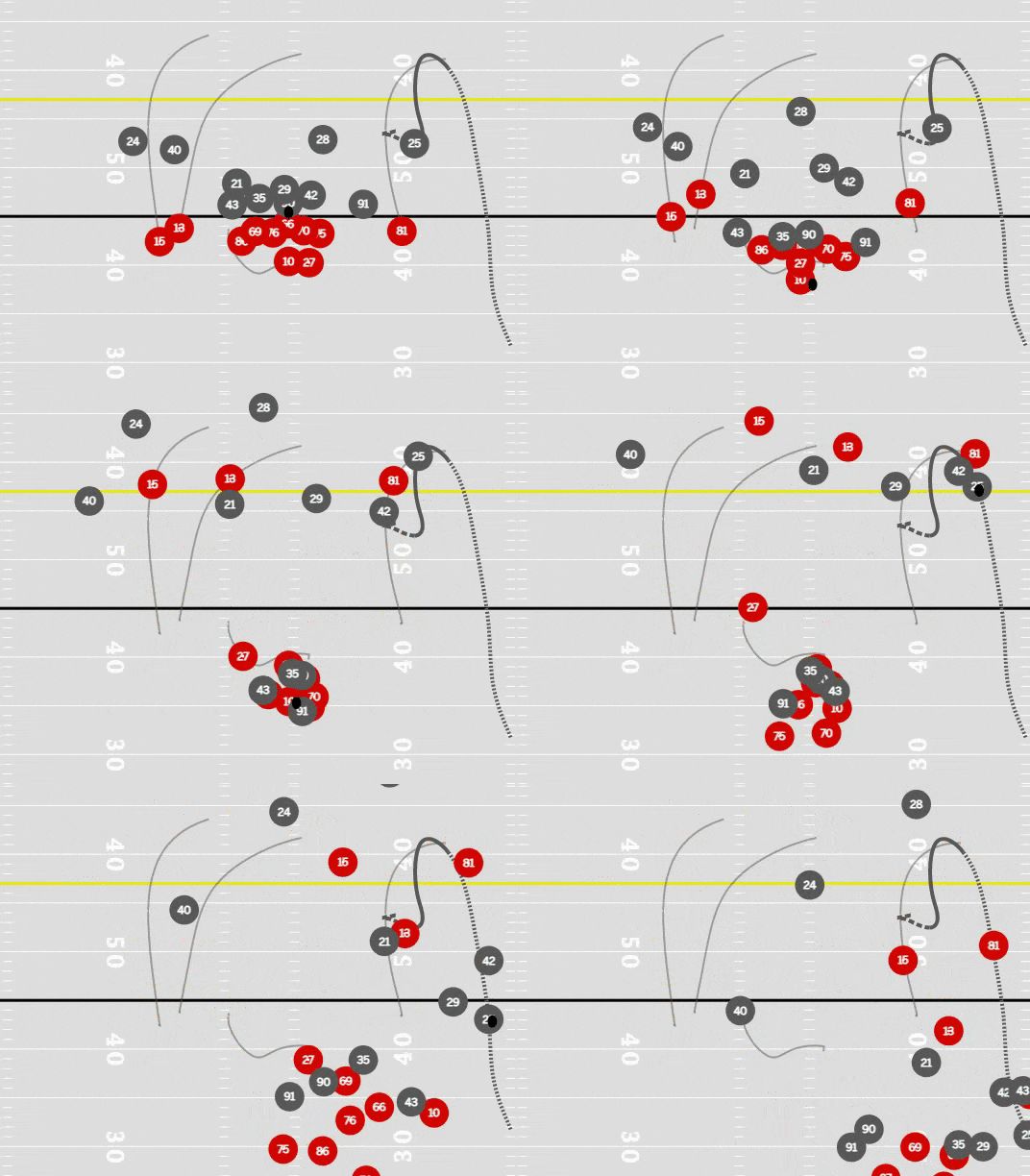
The Dolphins ran this amoeba front on four different third-down plays against Herbert (who had been great against the blitz), but the Dolphins evolved this package from primarily sending everyone on a blitz to dropping into zones.
Amoeba was the call for the play of the game, Howard's fourth-quarter interception that halted a potential go-ahead Chargers drive.
"Right before the ball is snapped, it looks like Cover 0, no safety in the middle of the field. It looks like you're sending everyone and playing man coverage. That's what it looks like Herbert reads," Bowen said.
"Off the amoeba front, they spin the safety to the deep middle of the field and get to three [defenders] deep and four [defenders] under -- that's Cover 3. Herbert doesn't read it well. He throws the out-breaking route. Howard is playing with an outside shade because he's the outside one-third [zone] corner, so he can flip the hips and drive on the football. Interception. That's an excellent use of late movement, disguise, scheme and your personnel."
The Dolphins' scheme is good and the personnel makes it great. Howard, the NFL's best ball hawk with more interceptions (20) than any player since 2017, knows he will have an opportunity and then will let his instincts take over.
"They mixed it up a lot," Allen said of the Dolphins' attack. "They ran Blitz 0 probably 20 times against the Rams. Every time they showed it, we thought they were going to bring it. Most of the game, they backed off and played coverage. So, they kind of messed with our playcalling a little bit."
The Dolphins' amoeba defense isn't new to 2020 or even exclusive to this team. This particular look originates from the New England Patriots, with whom Flores and Boyer used it as assistants under coach Bill Belichick. It began there early in Belichick's tenure and was revived in 2018 during a game against the Minnesota Vikings. One Dolphins player even referred to the package as "Viking" in 2019.
Though more commonly used by college programs now, other NFL defenses have used the amoeba in the past, most recently by coach Dom Capers' Packers, Romeo Crennel's Browns and Rob Ryan's Saints.
"Nobody's out there inventing anything," Boyer said. "Things evolve all the time and it's a copycat league."
Xavien Howard grabs the INT! #FinsUp
— NFL (@NFL) November 15, 2020
📺: #LACvsMIA on CBS
📱: NFL app // Yahoo Sports app: https://t.co/p1akRoFoep pic.twitter.com/PTS7QFeJ2k
But no other team does it better than the 2020 Dolphins defense, and its week-to-week evolution keeps offenses guessing. It's typically used on third downs or obvious pass situations, but sometimes the Dolphins don't run it all, like last Sunday against the Cincinnati Bengals. And sometimes they run it more frequently, like they did in games against the Chargers and Rams.
"I love it. I get excited because it's kind of like a mind game," Baker said. "You don't know who is down -- you get to hear all of the different checks. You kind of just mess with the offense. They might say I'm the Mike [linebacker]. I would mess with them and say, 'No, I'm not.' You have fun with it. Then you look up and a tackle or guard didn't hear and they asked, 'What happened?' The center snaps the ball, the next thing you know, we're in the backfield."
Dolphins linebacker Shaq Lawson adds: "It just puts a lot of stress on the offensive line when you do it, so they don't know which way to go. They mess up every time."
Week 8: Dolphins vs. Rams, second-and-2, 3:00 in first quarter
The Dolphins' pressure packages are plentiful, and the week-to-week changing of looks makes it hard to key on what is coming. The Dolphins can have success with it on a rookie like Herbert and a veteran rhythm passer like Goff. So, when you see 315-pound defensive tackle Christian Wilkins intercept Goff, it was the Dolphins' scheme that fooled him.
By outnumbering the Rams' protection, the @MiamiDolphins forced a quick pass by Jared Goff.@cwilkins42 knew it was coming and he was ready for it. 😏@NFLMatchup pic.twitter.com/tdhX2mD8Zf
— NFL Films (@NFLFilms) November 20, 2020
"They slide the protection, anticipating the six-man pressure. Jared Goff is going to throw hot. It's the smart play. But guess what, Christian didn't rush. When you have to make quick decisions, you miss that," Bowen said. "Not only does your scheme pressure count, you're also using so much late movement and disguise within your defensive front that you're causing conflict for the QB."
The Dolphins forced Goff into four first-half turnovers, largely by bringing relentless pressure.
Week 12 Dolphins vs. Jets, third-and-3, 10:23 in first quarter
Flores has been preaching scheme pressure since arriving in Miami in 2019, but it didn't work out so well last season because the Dolphins finished last in sacks (23). But in 2020, once the Dolphins added the personnel (signing cornerback Byron Jones, linebacker Kyle Van Noy, Ogbah, Lawson and drafting defensive tackle Raekwon Davis, safety Brandon Jones and cornerback Noah Igbinoghene) who match their scheme, the defense started to flourish. The Jones sack in the first quarter against New York shows how Miami's scheming pressure worked well.
#Dolphins tape -
— Matt Bowen (@MattBowen41) December 2, 2020
Really good defense to study for pressure & coverage. Multiple blitz fronts/concepts.
Match the RB release here + the FS looking to bracket/cut.
Pressure up front - with Jones blitzing. Scheme an open rush lane. @NFLMatchup pic.twitter.com/CQlAeDLPNu
"That's a very good example of rush and coverage. That had a very Patriots-like feel to me," Bowen said. "You had two outside linebackers, Van Noy peeled on the back instead of rushing. The other linebacker is just influencing the tackle. You got a defensive tackle occupying the guard, and because they're sliding protection up front, three-man slide, now there's a wide-open rush lane for Brandon Jones playing almost as Mike linebacker to get home to QB. Go to secondary, they take the free safety and bracket Jamison Crowder. It's about scheming pressure more than bringing pressure."
Sunday's big test
The Dolphins blitz on 38% of their opponents' dropbacks, fourth most in the NFL, and play man coverage on 54% of dropbacks, 11th in NFL, according to ESPN Stats & Information research. Through 12 games, opponents have a 59 QBR when the Dolphins blitz, good for sixth best in the NFL, and a 44 QBR against man, second best.
Mahomes ranks first in QBR against the blitz (97.3) and second against man (91). Defenses blitz him at only a 20% rate, third lowest in the NFL, but he still has 12 touchdowns to zero interceptions against it. Something has to give.
One sequence that showed this team's growth came in September. After going man-heavy in Week 1 against the Patriots, Buffalo Bills quarterback Josh Allen diced the Dolphins' man defense with a bevy of crossing routes in Week 2. But Miami made adjustments and went more zone in Week 3 vs. Jacksonville.
Sunday's game against the Chiefs will mark the biggest test of the season for the Dolphins' defense -- a unit that has exceeded expectations in Year 2 of a rebuild. It will be a chess match to see how Flores and Boyer combat Chiefs coach Andy Reid and offensive coordinator Eric Bieniemy's use of their talented playmakers.
Just like their amoeba defensive front, the Dolphins will need aggression, disguise and personnel to beat the Chiefs.