

See if you can remember the last time both teams scored in the UEFA Champions League final: What rings a bell?
It wasn't last year, of course, with Paris Saint-Germain's 5-0 demolition of Inter Milan being the most lopsided final of all time. The year prior, it seemed like Borussia Dortmund scored a couple of times in the first half against Real Madrid, but they didn't.
In 2023, Romelu Lukaku accidentally blocked a shot by his teammate to keep Inter Milan off the board. In 2022, Thibault Courtois was named Man of the Match precisely because he prevented Liverpool from scoring a goal.
No, the last time both teams scored in the Champions League final, Cristiano Ronaldo and Lionel Messi were still playing for Madrid and Barcelona, Fabian Delph was starting for the team that won the Premier League, no one outside of Norway yet knew who Erling Haaland was, and Lamine Yamal was 10 years old.
Dejan Lovren headed a long corner back toward the near post, and a sliding Sadio Mané beat Marcelo and Keylor Navas to the second ball. That put Liverpool level with Real Madrid in 2018 final, 1-1, in the 55th minute -- before Gareth Bale was subbed on, scored twice for Madrid, and effectively ended Loris Karius' career at the top level of European soccer.
But even though Liverpool scored in that game, Madrid still won by two goals and it didn't feel particularly close for much of the match. So, when was the last time we had a truly "good" game? You know, one where both teams score and the winner only wins by one?
For that, we'd have to go back to Bayern Munich's 2-1 win over Borussia Dortmund in ... 2013. There was also Real Madrid's shootout victory over Atletico Madrid after a 1-1 draw back in 2015-16.
We have this tournament, which is supposed to be the pinnacle of the most popular sport in the world -- the only place where all of the best teams and players compete directly against each other, with career-defining stakes. And yet, the showpiece for said tournament -- the game that decides the winner and theoretically pits two of the best teams in the world against each other -- hasn't been genuinely competitive in at least a decade.
Ahead of Saturday's final between PSG and Arsenal, we have to ask: That seems like a problem, doesn't it?
Why do tournament finals disappoint?
If you think about all the major American sports -- baseball, basketball and football -- there's a similar issue.
The NFL is by far the most popular league of the three, and its "final" is literally called the "Super Bowl." The game is one of the remaining vestiges of an American monoculture, so much so that nearly 30 million people take off work the next day. But the game itself? It usually stinks.
Last year, the Seattle Seahawks won by 16 points over the New England Patriots, and despite a stretch of close games before that, nearly a third of all Super Bowls had a winning margin of 17 points or more. Again, this is in games that are supposed to be pitting two of the best teams in the NFL against each other.
While the NFL has won the economic battle over the NBA and MLB, the NBA Finals and the World Series are just way better to watch. And they frequently feel like the pinnacle of the sport -- like you're actually watching the best in the world play their best.
Like all of the previous rounds of the playoffs, the championships are decided across a series of games rather than a one-off. Plus all of the games are played in the home arenas of the participants. The crowds are better, the environments are familiar, and the quirks that define each specific team get maintained throughout each series.
The Super Bowl, though, gets played in a preselected neutral location. There's a concert at halftime. And a large chunk of the people in the stands -- perhaps most of the people in the stands -- aren't fans of either team.
That, too, is what the Champions League now looks like. Linkin Park performed before last year's final because apparently 14-year-old me was put in charge of pregame programming. Rap-rock is an artform! This season, well, here's how UEFA describes what we can expect before Saturday's match in Budapest, Hungary:
"The Killers will headline the 2026 UEFA Champions League Final Kick Off Show presented by Pepsi. To launch this year's show, The Killers appear alongside Sir David Beckham in a new short film titled The Race Begins. The cinematic storyline follows lead singer Brandon Flowers and Beckham in a playful, high-stakes race to reach the most highly-anticipated match of the season ..."
Now, the experiences at most of Europe's big-club stadiums are being increasingly corporatized, too. Who cares if Spurs might get relegated? You can ride in a Formula 1 simulator while you eat line-caught fish and chips at halftime! But watching a game at the Emirates is different from the Parc des Princes is different from Anfield is different from the Santiago Bernabeu. When everyone's emotions line up just right -- or the stakes are high enough -- top-level matches can still become an ecstatic, collective experience.
That is, except during the most important game of the soccer season, when a team from London and a team from Paris will square off in Budapest.
And then there's the issue of how the champion is decided. We play two games at every stage -- except for the final. Not only does that introduce more randomness into who actually wins the final than who actually reaches the final, but it also changes the incentives for everyone involved. You want to win, of course, but you now know you can win by not giving up a goal and then winning a shootout.
If you score early during a two-leg tie, then you have a really long way to go to preserve that lead. If you score early during the Champions League final, you've only got to grind out fewer than 90 remaining minutes, and you'll win the whole thing.
All of this then converges in how the teams end up playing. All the markers of conservative or disjointed play pop up when you look at the finals compared to the semifinals. This data from Stats Perform goes back to 2010:
- Fouls per game: 28.2 in finals, 25.6 in semifinals
- Possessions won in the attacking third per game: 6.8 in finals, 7.8 in semifinals
- Through balls per game: 2.4 in finals, 5.2 in semifinals
- Touches in the box per game: 26.8 in finals, 29.0 in semifinals
- Percent of final-third passes that are crosses: 15.4% in finals, 13.5% in semifinals
Teams are breaking up play more often to slow games down. They're not pressing as aggressively. And there's either less space in the attacking third or teams are more conservative in the attacking third, but whatever the answer: it leads to a more low-value crosses, as opposed to high-value through balls.
So, the environment is boring and sanitized, the quality of play is worse, and the games are rarely actually competitive. But other than that ...
It's hard to see how this wouldn't be improved by turning the final into a two-leg, home-and-away matchup. It's also hard to see how UEFA wouldn't be able to find a way to make more money from two games instead of one.
But as it stands, the organization fields bids for the opportunity to host the final, and that gives them a major power lever over all of their member countries. Plus, the interested parties -- the clubs, the players, and even the fans -- only make up a tiny portion of their own respective populations, so it's not likely to become a politicized issue at any point soon, especially since it would add a match to an already bloated calendar.
Based on the way things are going, we'll see a Champions League final in Miami or Tokyo before we see a two-legged final.
Will Saturday's Champions League final be any different?
The bounce of the ball decides these finals more than anything else, and had a ball or two bounced differently, I wouldn't have been able to point out how it's been two World Cup cycles since both teams scored in a Champions League final, or how it's been a decade since we had a genuinely competitive and exciting final.
Take 2022, where Liverpool attempted 24 shots, created 1.85 expected goals, turned that into 2.05 post-shot xG with the accuracy of the attempts, and scored none because Thibault Courtois was allowed to clone himself right before the game started:
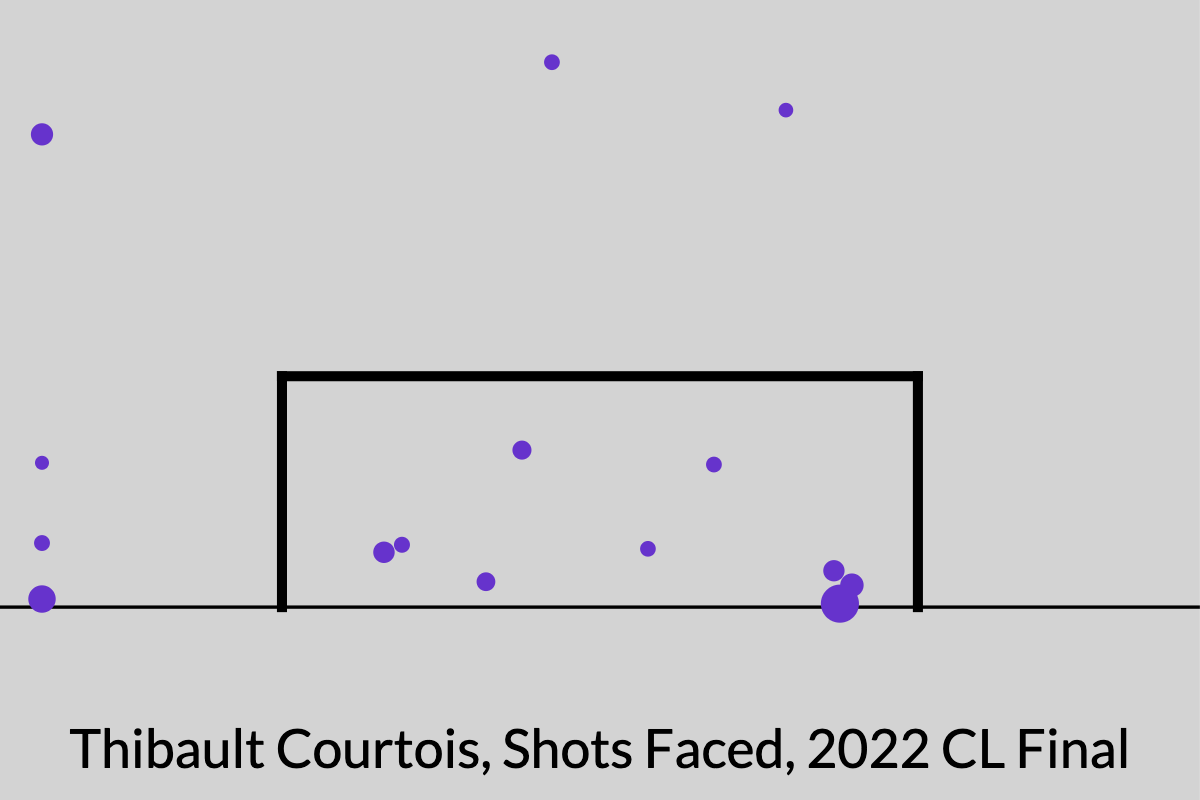
Purple dots are shots, and orange dots are goals. Yes, you're reading that chart correctly.
If one of those shots goes in, and Madrid then have to try to attack more than they did -- they won the Champions League final despite attempting only four total shots -- maybe this game becomes a classic.
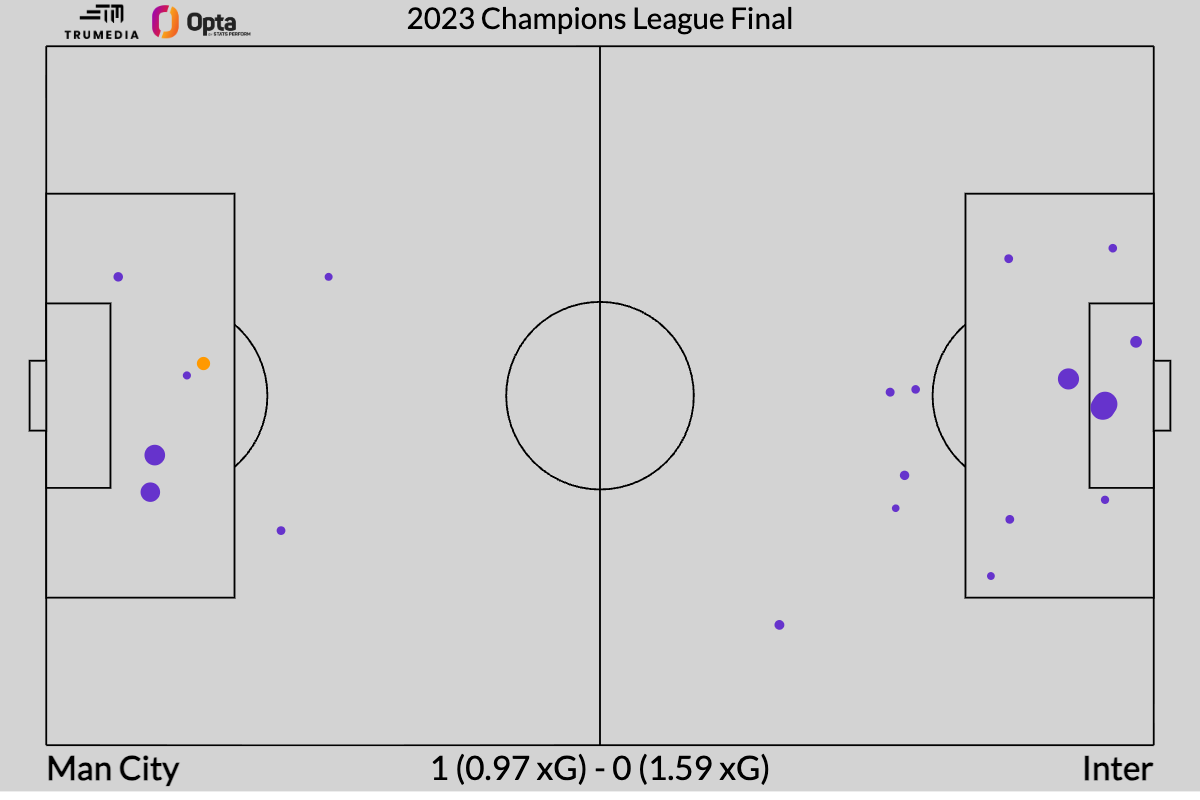
In 2016, both Madrid clubs created enough chances to score three times, but neither one converted more than one. The 2019 final turned because Sadio Mane kicked the ball into Moussa Sissoko's hand. And check out the shot map for the 2023 final, which turned Manchester City into treble winners:
But how did we feel going into each of these matches?
Based on the historical odds kept by Covers, these were the implied odds ahead of the past 10 Champions League finals:
A quick aside: Based on their pregame betting odds, we'd expect Madrid to win 2.7 Champions League titles over this stretch. They, of course, won five. And the chances of that happening -- again, based on the odds -- was 4.8%. In retrospect, Madrid's titles all felt inevitable. In reality, that run was incredibly unlikely.
Anyway, the average favorite came into the final with a 63% chance of winning -- a number that feels quite high, given that these matches should be featuring two of the best teams in the world and that there's no homefield advantage boosting either side.
And so, perhaps another reason the finals haven't been competitive is that, thanks to the randomized draw and the random nature of the sport when it's plunged into a small-sample knockout tournament, the two best teams in the world are rarely the two teams that reach the final.
On top of that, the favorite has won eight of the past 10 titles -- Chelsea and Madrid's back-to-back wins were the only underdog victories.
It might be tempting to expect more of the same Saturday. PSG steamrolled through the knockout rounds for the second straight year. They've turned Ligue 1 into a nine-month-long periodization program that helps them peak in the spring. And all of their young players are even better than they were a year ago, when they won the final, 5-0.
Arsenal, meanwhile, just won the Premier League by gritting their teeth through the final few months. They've been battling injuries all season long. They landed on the easy side of the draw, especially after Atletico Madrid took down Barcelona in the quarters. And their winning formula is not exactly designed to maximize goal scoring.
Will PSG just pin the Gunners back and pound them into submission? It could happen, but I doubt it. What Saturday's final offers that most others haven't is a true contrast in strengths: PSG are a high-pressing team that want to score lots of goals and create all kinds of action, while Arsenal are an elite defensive team that want to suck the life out of matches and score on set pieces.
Usually, though, when we see that kind of stylistic battle, it's pitched between one stronger side and one weaker side: The favorites press and possess, while the underdog must defend at a high level in order to survive.
But this year's final is a matchup of equals. Arsenal have tons of money and lots of depth; they simply just chose to play a different way than most top teams typically do. Based on the Club Elo ratings, a purely results-based formula that accounts for game location, opponent difficulty, and match importance, Arsenal are the highest-rated team in the world, while PSG sit fourth.
The betting odds put PSG as 57% favorites, making this the closest matchup since 2018, when the unthinkable happened and both teams actually scored goals in the same game. Here's to a repeat on Saturday.